
I Build Companies Worth Owning and Leaders Worth Following.
I Build Companies Worth Owning and Leaders Worth Following.
A business growth ecosystem equipping Founders, Investors, and Operators with the systems, tools, capital, and support to build profitable, self-sustaining companies.

Latest
Blog Articles.

The Four Mental Stages of Sales Rep Performance
Most owners misread what is happening when a salesperson's confidence drops. They assume the person is the problem, the product is the problem, or the market is the problem, when in many cases they are simply watching someone move through the hard middle of learning.
That misread is expensive.
It causes leaders to lose good people too early. It causes new salespeople to internalize a normal stage of development as personal failure. And it causes companies to keep treating emotional turbulence like a hiring mistake when what they are really seeing is the cost of learning to do hard things under pressure.
I have watched this happen enough times to know the pattern is real.
A salesperson named Gerry was hired into a manufacturing company that made premium service and utility truck toolboxes. On paper, he looked strong. He had experience, confidence, and the kind of personality most owners are relieved to hire. He believed he would justify his base salary quickly and perform at a high level almost immediately.
Very early on, that confidence looked justified. He went out prospecting and came back with a major RFQ from a new truck upfitter. If you were only looking at that moment, you might have assumed he was on his way.
But early confidence is not proof of mastery.
What came next was what often comes next. The work got harder. The conversations got more complex. Resistance showed up. The gap between what seemed simple at the beginning and what it actually took to sell successfully became impossible to ignore. His confidence dipped.
That dip did not mean he was the wrong hire. It meant he had entered the real learning curve.
As leaders, we need to understand that curve well enough to lead people through it. More than that, we need to teach it to them so they can consciously navigate their own development instead of being ruled by whatever they happen to feel that week.
Why early confidence often tells you very little
Most new salespeople begin with what I would call borrowed confidence. They are optimistic because they have not yet been exposed to the full difficulty of the role. They know enough to feel good, but not enough to understand what the work is going to demand.
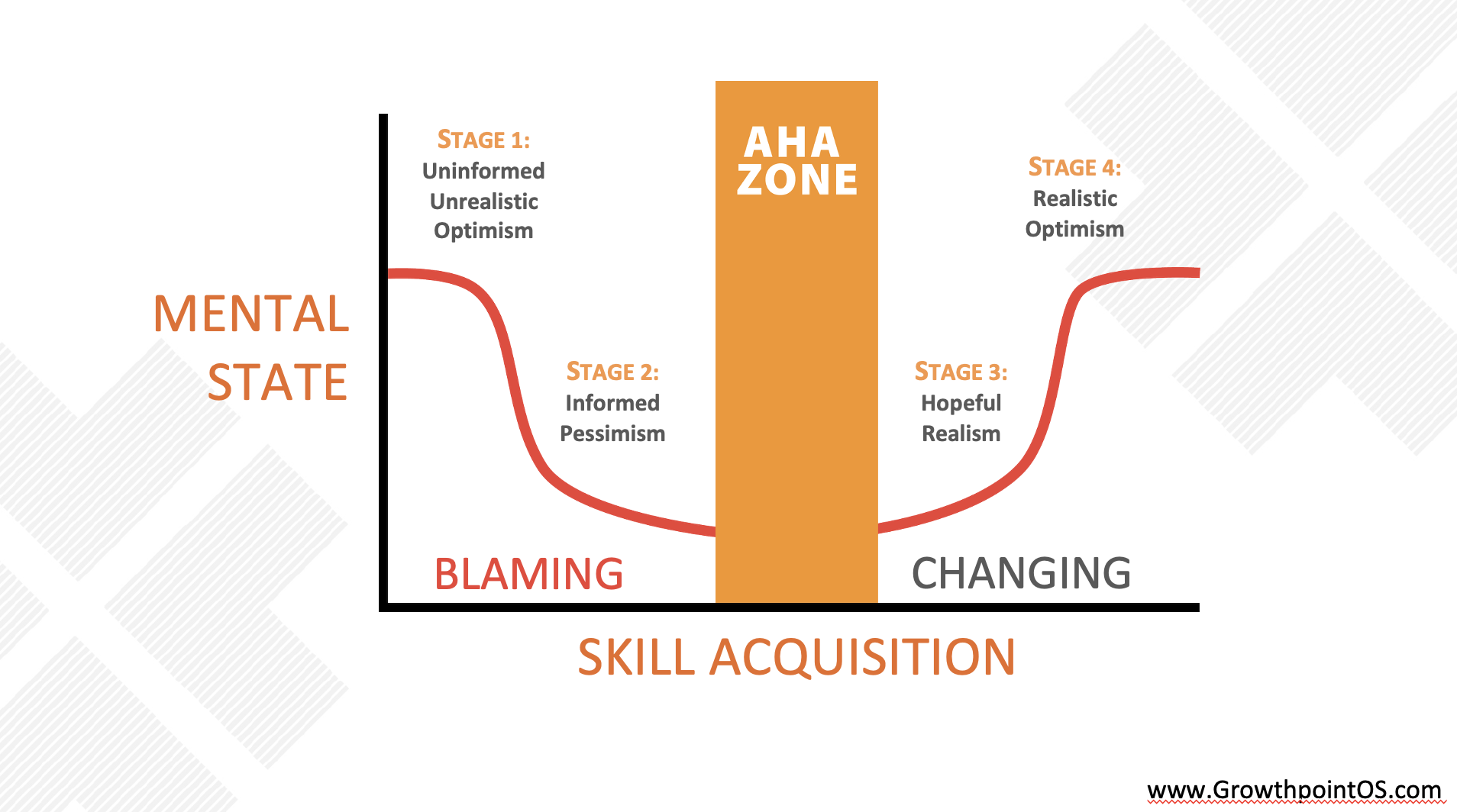
That is why the first stage in this development curve is so useful. In the training graphic, it is called Uninformed Unrealistic Optimism. That is a clunky phrase, but it describes something very real.
At the beginning, the salesperson sees the opportunity, not the resistance. They hear the product story, not the objections. They picture the commissions, not the long sequence of disciplined actions required to earn trust, create movement, communicate value, and motivate a purchase.
That stage is not wrong. It is just incomplete.
The problem comes when owners interpret that early confidence as proof that the person is already farther along than they really are. Then, when reality shows up and confidence falls, everyone feels surprised. Nobody should be surprised.
If you are leading salespeople, this is part of your job. You do not just manage activity. You interpret development.
The crash is not failure. It is exposure.
Once the salesperson has enough real reps, reality starts teaching what enthusiasm never could. They begin to see how much judgment the role requires. They start feeling the weight of timing, tone, positioning, follow up, persistence, and the emotional cost of hearing no.
This is the stage where confidence often drops hard.
In the training framework, that valley is labeled informed pessimism. The person now knows enough to feel the difficulty, but not enough yet to move with real confidence inside it. What changed is not their character. What changed is their awareness.
That is why this stage should not be treated as failure. It is exposure. They are finally seeing the work more honestly.
A lot of owners panic here. They assume the salesperson has lost their edge. They assume motivation is fading. They assume they made a bad hire. Sometimes those things are true. Often, they are not.
Often, you are simply watching someone move from naive confidence to honest awareness. That is painful, but it is necessary.
If you do not understand that, you will keep mislabeling development as dysfunction.
Blame feels easier than ownership
There is a reason this stage becomes dangerous.
When people feel discouraged and do not understand why, they start looking for something to blame. The leads are bad. The pricing is wrong. The product is too hard to sell. The market is soft. The company does not know what it is doing. Sometimes there is some truth mixed into those complaints. But blame becomes a trap when it keeps the salesperson from seeing the deeper issue.
They are still becoming.
That is one of the most important jobs a leader has in this season. You have to help the salesperson understand that low confidence is not always a verdict. Sometimes it is simply the emotional experience of being in the middle of skill acquisition.
When a person can name that, they can rise above it.
They can stop making every hard day mean something catastrophic. They can stop interpreting emotional discomfort as proof they are not cut out for the work. They can stop burning energy on blame and start investing it in practice, coaching, correction, and disciplined activity.
That shift matters.
Because growth begins when the salesperson moves from external blame to internal ownership. Not shame. Ownership. They accept that the way through is not emotional escape. The way through is development.
Why activity matters so much in the hard middle
There is a moment in the learning curve when things begin to connect. Not all at once. Not dramatically. But enough for the salesperson to feel that what they are doing is starting to make sense.
In the graphic, this is the AHA zone. After that, the person begins to move into what the framework calls hopeful realism. That is a far healthier kind of confidence. It is not loud. It is not naive. It is simply grounded enough to keep going.
This is where repetition starts turning into pattern recognition.
The salesperson begins to notice what good conversations have in common. They start hearing objections before they arrive. They learn how to recover when a call goes sideways. They begin to understand not just what to say, but why it works.
That kind of clarity does not come from inspiration. It comes from reps.
That is why I like this line so much: Rainy days are inevitable, but activity should be used as the umbrella to get us through to brighter days ahead.
That is not just motivational language. It is operational truth.
When a salesperson is in the valley, disciplined activity matters because activity creates learning. More calls, more conversations, more follow up, more real contact with the market. That is how the fog starts to lift. Not by waiting to feel confident again.
As a leader, you need to protect that truth. You need to remind your team that the answer to discouragement is not retreat. It is guided repetition.
Real confidence has to be earned
Eventually, if the person stays in the process long enough, something steadier begins to form. In the framework, this final stage is called realistic optimism.
That is the kind of confidence you actually want in a salesperson.
Not inflated certainty. Not loud self-belief detached from results. Realistic optimism is confidence built on competence. The person has seen enough, failed enough, adjusted enough, and succeeded enough to trust themselves for the right reasons.
This is why mature sales confidence feels different. It is calmer. Less performative. Less fragile. The person is no longer optimistic because they do not know what is hard. They are optimistic because they do.
That is a much stronger kind of belief.
And for an owner, it is a reminder that durable confidence in your team is usually being built long before it is visible on the surface. It is built in the discouraging middle. In the coached conversations. In the corrected habits. In the reps nobody celebrates.
What owners must do with this framework
If you own the business or lead the sales team, you need more than awareness of this pattern. You need a way to communicate it.
Your people should know these stages before they hit them. They should be taught that confidence often drops before it rises again. They should know that blame is a temptation in the valley. They should understand that activity, coaching, and ownership are what carry them through. And they should be reminded that the emotional burden of learning something difficult is not evidence of failure.
That kind of teaching changes things.
It shortens the valley. It lowers unnecessary shame. It gives the salesperson language for what they are experiencing. And it helps you lead with patience without becoming passive.
This is one reason I think owners need to take onboarding more seriously than most do. Onboarding is not just product knowledge, territory maps, and CRM steps. It is also helping a person understand what the development process is going to feel like so they do not misinterpret the hard middle and quit too early.
Good leadership does not remove the valley. But it does help people walk through it with clarity.
The deeper issue is leadership, not emotion
At the surface, this article is about sales confidence. Underneath, it is about leadership.
Owners who do not understand the emotional stages of learning tend to overreact to discouragement and underinvest in development. They make decisions based on the mood of the moment instead of the structure of growth. That is how promising people get mislabeled, mishandled, and lost.
The better approach is calmer and more disciplined.
Teach the stages. Normalize the dip. Coach the habits. Measure the activity. Watch for ownership. Stay close enough to help the person think clearly while their confidence is still catching up to their development.
That is how you build salespeople who are not just enthusiastic in week one, but competent and steady over time.
And if you want your team to consciously navigate this process instead of stumbling through it, I would strongly consider giving them a simple training tool during onboarding that explains these stages in plain language. Sometimes one page of clarity can keep a good person in the game long enough for real competence to emerge.
If this is the kind of founder and sales leadership conversation you want more of, spend some time at thedavidrobertson.com and subscribe to Founder's Memo. That is where I write about the realities of leadership, growth, and building teams that can carry real weight.


Let's
Connect.
Have a question or want to connect with me?

David Robertson is a serial entrepreneur, investor, and coach passionate about Advancing the Kingdom of Christ in business.
© David Robertson | All Rights Reserved | This Site Designed by GrowthpointCRM™
Disclaimer:
All content on this website is authored by David Robertson, an experienced business consultant. The views and opinions expressed are his own and do not reflect those of any current or former employers, including International Services, Inc. (ISI) or its affiliates. Professional on-site consulting services are currently provided exclusively through ISI or its affiliated companies. Employment statuses and affiliations are subject to change without notice.
Any investments or investment activities mentioned are conducted solely through Robertson Equities, LLC. and are not associated with or endorsed by ISI or its affiliates. ISI and its affiliates are not responsible for the content on this website or any online activities conducted by David Robertson.
David Robertson makes no representations as to the accuracy or completeness of any information on TheDavidRobertson.com or from any links found on this site. He will not be liable for any errors or omissions, nor for the availability of this information.