
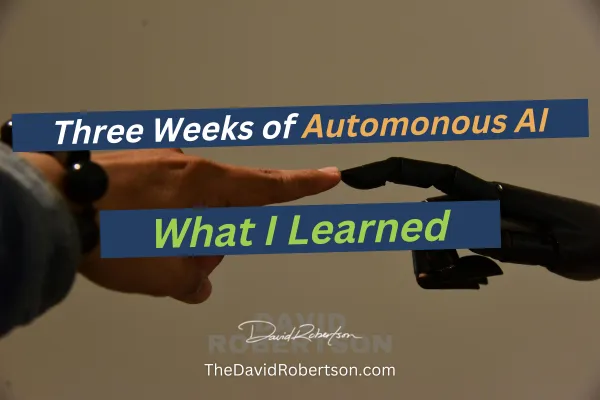
Amplify, Don't Replace: What Three Weeks of Autonomous AI Taught Me
Amplify, Don't Replace: What Three Weeks of Autonomous AI Taught Me
You've heard the pitch. Robots will do your work. Cut your payroll. Solve problems you didn't know you had. Three weeks ago, I decided to test it. Not the hype. The reality.
I built a system where autonomous AI agents handle the work that was stealing my time from clients and strategy. I set them loose with clear instructions and measurable outcomes, and they ran 24/7 without exhaustion, complaint, or the burden of overtime.
What happened next wasn't shocking because the technology worked. It was shocking because it forced me to answer a much harder question: What am I actually trying to do with this power?
Why Capability Is No Longer The Bottleneck
The first thing you need to know is that this is not theoretical anymore. AI agents can execute virtually any computer-based task. Give them clear instructions. Define what success looks like. They will do it while you sleep, while you're with a client, while you're thinking about something else entirely.
I watched this unfold in real time. Agents running business processes. Managing workflows. Handling the kind of repetitive execution that used to require a person sitting at a desk eight hours a day. The technology is not coming. It is here.
The limiting factor is no longer whether AI can do the work. The limiting factor is whether you have decided what you actually want it to do.
The Difference Between Amplification And Replacement
This is where most conversations about AI go wrong. People see the capability and assume the benefit is cost reduction. Fewer people on the payroll. Lower labor expense. Faster execution. Those things are true.
But they are not the real opportunity.
There is a profound difference between using AI to do what you should have handed off to a person, and using AI to multiply what humans are actually capable of thinking and creating. One is substitution. The other is multiplication.
Substitution looks like this: You had a person doing data entry. Now an AI agent does it. Cost goes down. Problem solved?
Multiplication looks like this: You free that person from data entry so they can do the thinking work. The strategic conversation. The judgment call. The relationship building. The work that requires wisdom, not just execution.
I realized three weeks in that the real leverage Ai made possible was not in removing payroll. It was in what our teams become capable of when they were no longer chained to repetitive mindless work.
Why Capacity Matters More Than Cost
A business that needs the output of five people can now accomplish that with three people plus AI agents running in the background. The difference is not downsizing. It is not extracting more from fewer people. It is freedom.
Your team stops doing work that a machine can do better anyway. They stop being hands. They become minds. That shift changes everything about your business.
You can scale capacity without scaling payroll. More importantly, you can scale capacity without scaling the founder's workload. And that second part is what actually changes the value of your business.
Owner dependence is the silent killer of business value. You can be profitable and still not be sellable because the business runs through you. You can be growing and still be suffocating because there are not enough hours in the week to manage everything that depends on your decisions.
AI agents do not solve that problem by themselves. But they free up enough time for you to actually build the systems and delegate the authority that would have solved it anyway.
What You Can Actually Multiply With This Power
The real leverage is in what you ask, not what you automate.
I believe the world around us is using AI backwards. You ask; AI answers. The human is removed.
What is AI asked the questions, we fed it knowledge and AI executes decisions instead of making them. AI processes information. It does not interpret what that information means for your future.
A human who knows what questions matter. Who can see three moves ahead. Who makes the calls that require conviction and moral clarity. That founder becomes exponentially more powerful when their execution capacity is multiplied by agents working 24/7.
I did not get more hours in the week. I got smarter about what I chose to do with the hours I have.
That is what AI amplification actually enables. Not the elimination of work. The elevation of work. Not the removal of leadership. The multiplication of leadership across the organization because now you have capacity to actually lead.
The Deeper Choice Nobody Wants To Name
Here is what surprised me three weeks in. The technology was not the hard part. The hard part was confronting the question I started with: What am I actually trying to do with this power?
Because the answer determines everything.
If you use AI to eliminate human wisdom and creativity from your business, you made a profitable mistake. You extracted more value in the short term and built something smaller in the long term. You optimized for extraction instead of stewardship.
If you use AI to extend human vision into work you could never reach alone, you are stewarding something sacred. You are multiplying the impact of human insight. You are building a business that thinks differently because humans are free to think at a higher level.
One approach builds extraction. The other builds legacy.
This is not soft sentiment. This is structural business strategy. The companies that will win in the next decade are not the ones that automated away their humanity. They are the ones that amplified it.
The businesses worth building are the ones where AI handles execution and humans handle vision. Where machines do what machines do best and people do what people do best. Where the founder's time gets spent on decisions that only the founder can make, not on work that a computer could do better.
That is what I realized three weeks in.
The Decision Is Yours To Make
We are standing in front of something monumentally dangerous or revolutionary. Both are true. We get to decide which one it becomes.
The choice is not whether to use AI. The choice is what you are amplifying with it. Are you amplifying the profitable extraction from your business, or are you amplifying the human vision, creativity, wisdom, and insight that makes your business worth building in the first place?
If you amplify extraction, you will get more money and lose your soul. If you amplify vision, you will build something that matters.
The technology is neutral. Your decision is not.
If this is the kind of founder conversation you want more of, spend some time at thedavidrobertson.com and subscribe to Founder's Memo. That is where I write about the decisions that actually shape companies worth building.